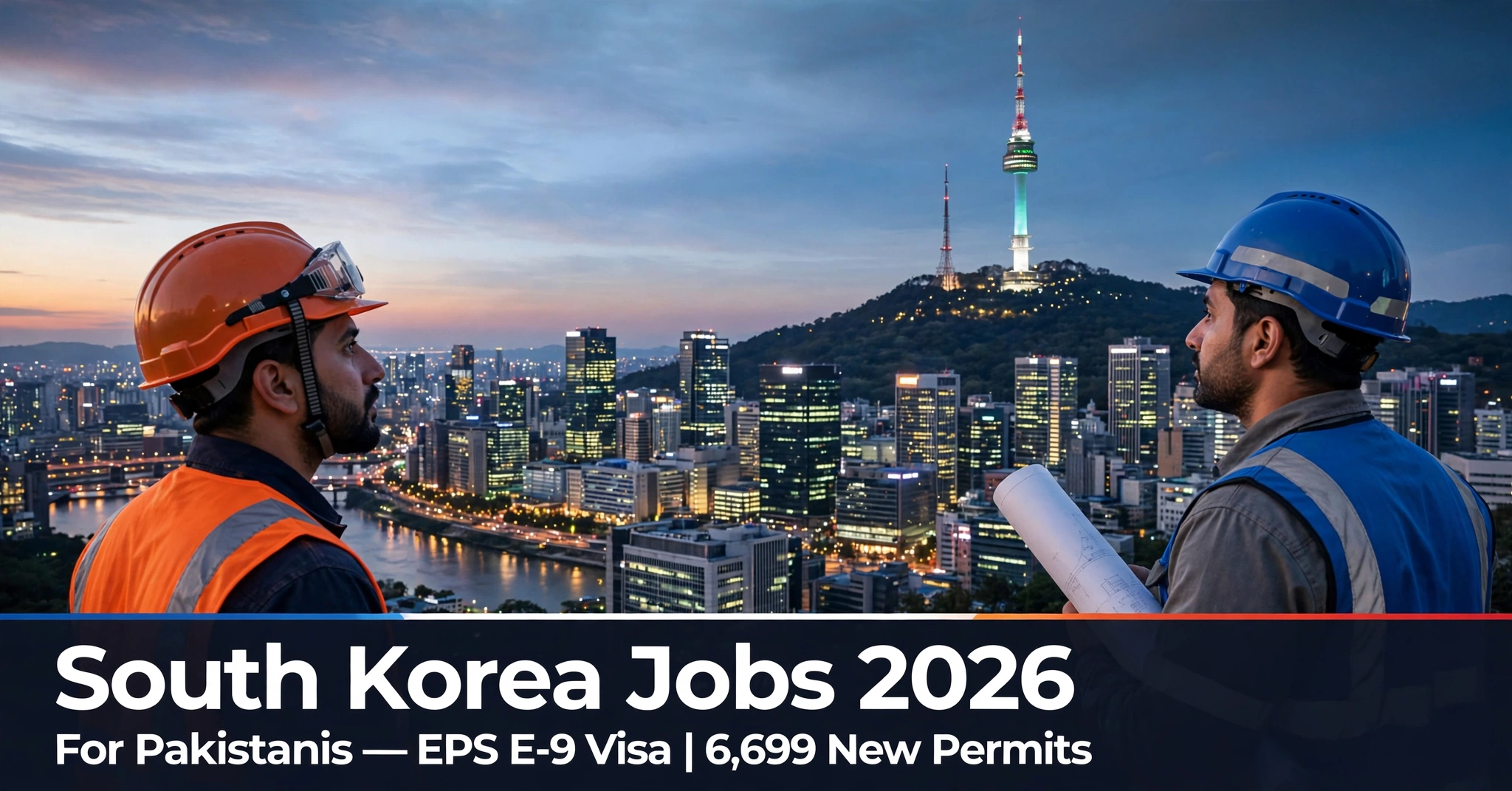
South Korea Jobs 2026 for Pakistanis — 6,699 New E-9 Permits Announced
South Korea jobs 2026 for Pakistanis are open through the Employment Permit System (EPS). On 12 November 2026, South Korea’s Ministry of Employment and Labor announced the fifth round of E-9 employment permits for 2026 — 6,699 new permits for foreign workers, with employer applications running from 23 to 27 November 2026. For Pakistanis, this is a government-to-government route: no agent and no “direct visa” seller, just the Overseas Employment Corporation (OEC) and Korea’s HRD Korea. The Bureau of Emigration and Overseas Employment (BEOE) also confirmed the EPS opening for Pakistani workers on 26 October 2026. In fact, the 2026 minimum wage in Korea is ₩10,320 per hour — about ₩2,156,880 a month, roughly Rs 446,000.
Job Overview
| Organization | Ministry of Employment and Labor, South Korea (via EPS / HRD Korea); OEC Pakistan |
| Programme | Employment Permit System (EPS), E-9 work visa |
| Total permits (5th round) | 6,699 new E-9 permits |
| Sectors | Manufacturing, agriculture & livestock, fisheries, construction, services |
| Last date | 27 November 2026 (employer permit applications close) |
| Location | South Korea (nationwide) |
| Education | No degree required — EPS-TOPIK Korean language test is mandatory |
| Age limit | 18 to 39 years |
| Salary | ₩10,320/hour; ₩2,156,880/month (~Rs 446,000/month) |
| How to apply | Through OEC Pakistan only — jobs.oec.gov.pk |
Vacancy Details — 5th Round E-9 Permits
Overall, South Korea’s fifth and final 2026 round of new E-9 permits covers 6,699 workers: manufacturing 4,510; agriculture and livestock 954; fisheries 897; construction 198; and services 140. However, if demand in any sector exceeds its allocation, the ministry will actively use an additional flexible allocation of 10,000 permits. Korean employers must first try to hire locally for seven days before applying for a foreign worker permit, through local employment offices or the Employment 24 website.
However, one important clarification: the 23–27 November window is for Korean employers to apply for employment permits. Therefore, Pakistani workers do not apply directly in this window. Instead, HRD Korea matches EPS-TOPIK passers already on Korea’s job-seeker roster to these permits — so being on the roster is the real first step for a Pakistani applicant.
Salary in South Korea
Korean law requires employers to pay EPS workers at least the legal minimum wage. For example, in 2026 that is ₩10,320 per hour — ₩2,156,880 per month on the standard 209-hour month, approximately Rs 446,000 (at 1 KRW = 0.2071 PKR, 17 November 2026), before overtime. From 1 January 2027 the minimum wage also rises to ₩10,700 per hour — ₩2,236,300 per month, roughly Rs 463,000 — as the Ministry of Employment and Labor confirmed in August 2026. Moreover, employers pay overtime, night and holiday work extra under Korean labour law, and EPS contracts include employer-provided accommodation and food arrangements plus labour-law protections.
However, Korea cut the 2026 E-9 quota to 80,000 new workers, down from 130,000 in 2025, so competition for roster places is tighter than before. Overall, EPS now runs with 18 sending countries.
Eligibility Criteria
- Age: 18 to 39 years (each OEC recruitment notice confirms the exact limits).
- Nationality: Pakistani citizen with a valid passport.
- Language: Must pass the EPS-TOPIK test (Test of Proficiency in Korean), a computer-based exam testing reading and listening. You do not need a degree, but passing the test is compulsory.
- Health: You must also meet the prescribed medical fitness conditions.
- No agent needed: Indeed, OEC is the sole official body for EPS recruitment in Pakistan — no private agency can recruit for EPS.
However, passing EPS-TOPIK does NOT guarantee a job. Instead, it only places the candidate on Korea’s job-seeker roster, valid for two years from the final result announcement, from which Korean employers select workers.
How to Apply — Step by Step
- First, watch for the OEC announcement. In fact, the 2026 (9th point system) pre-registration window ran 6–20 March 2026 and has now closed. OEC announces the next round on oec.gov.pk and the OEC jobs portal jobs.oec.gov.pk — so check both regularly, as windows open with short notice.
- Next, pre-register with OEC. When a window opens, pay the pre-registration fee (approximately PKR 1,000) at HBL Bank using the OEC challan form, then register online by uploading the paid challan scan.
- Then, prepare for EPS-TOPIK. OEC runs Korean language classes — its Lahore classes started 19 October 2026 (45 days, Rs 12,000 fee). In addition, the EPS-TOPIK fee is usually around US$24–28, announced in each round’s notice.
- After that, sit the EPS-TOPIK test at the designated centres in Pakistan. In addition, OEC posted the first-round EPS-TOPIK 2026 result on 23 October 2026, and passers sat a skills test in Islamabad in early November 2026. Finally, you can check results on the OEC portal by KLT number.
- Therefore, complete the skills test and documents stage if you pass round one — passing it is compulsory, and OEC does not treat anyone who skips it as successful.
- Next, join the roster and wait for employer selection. For example, HRD Korea matches roster workers to employer permits, such as the 6,699 permits in the fifth round.
- Lastly, get the E-9 visa and BEOE protector. After selection, selected workers receive the E-9 visa — valid for an initial 3 years, extendable to a maximum of 4 years and 10 months — and must obtain the BEOE protector stamp before departure.
Also, for help, contact the OEC EPS help desk at +92-51-9253245 or eps@oec.gov.pk.
Important Dates
| 5th-round E-9 permits announced | 12 November 2026 |
| Employer permit applications open | 23 November 2026 |
| Employer permit applications close (last date) | 27 November 2026 |
| Results announced | 11 December 2026 |
| Permits issued — manufacturing & mining | 14–16 December 2026 |
| Permits issued — agriculture, forestry, construction & services | 17–21 December 2026 |
| Minimum wage rises to ₩10,700/hour | 1 January 2027 |
| Next OEC EPS-TOPIK registration round | To be announced on oec.gov.pk |
Visa and Work Permit Information
Pakistani workers also enter Korea on the E-9 non-professional employment visa under the EPS, valid for an initial 3 years and extendable to a maximum of 4 years and 10 months. However, there is no separate “direct” E-9 application outside OEC and HRD Korea. In contrast, skilled professionals have a separate route: the E-7 skilled worker visa, for designated occupations such as IT engineers, software developers, data scientists and healthcare professionals, through direct employer recruitment. South Korea’s Ministry of Justice also approved slaughterhouse work as an E-7-3 occupation in a two-year pilot through December 2027 — the pilot caps places at 150 workers a year, and applicants do not need a university degree.
In short, anyone offering a “Korea work visa” for lakhs of rupees, or claiming to recruit for EPS privately, is not part of the programme. In fact, OEC states plainly that it is the sole official body for EPS recruitment in Pakistan. Therefore, never pay an agent for a job offer or a visa token.
FAQs
- How can Pakistanis apply for jobs in South Korea in 2026?
In short, only through the Employment Permit System (EPS), which OEC runs in Pakistan with Korea’s HRD Korea. Register on jobs.oec.gov.pk when OEC announces a round, pass the EPS-TOPIK Korean language test and the skills test, join the job-seeker roster, and wait for a Korean employer to select you for an E-9 visa. - What is the salary for EPS workers in South Korea?
In fact, at least the Korean minimum wage: ₩10,320 per hour in 2026, or about ₩2,156,880 a month (roughly Rs 446,000) on a standard 209-hour month, excluding overtime. After that, from 1 January 2027 it rises to ₩10,700 per hour (about ₩2,236,300 a month, roughly Rs 463,000). - What is the last date for South Korea jobs 2026?
Overall, the fifth-round E-9 employer permit applications close on 27 November 2026, with results on 11 December 2026. For Pakistani applicants, OEC has not announced the next EPS-TOPIK registration window yet — therefore, watch oec.gov.pk, because windows open with short notice. - Does passing EPS-TOPIK guarantee a job in Korea?
No. However, passing the test and the skills test only places you on Korea’s job-seeker roster for two years. Final job offers depend on demand from South Korean employers, who select workers from the roster based on their requirements.
Browse all the latest openings in our Jobs category
Japan jobs 2026 for Pakistanis
Australia jobs 2026 for Pakistanis